An exhibition of censored artwork in Nagoya city triggers a furious debate on artistic expression. The artistic director of the Aichi Triennale 2019 had few illusions when he planned an exhibition called "After Freedom of Expression". By choosing items that poked painfully at some of Japan's most tender spots - war crimes, subservience to America and the status of the imperial family - Tsuda Daisuke wanted to "provoke discussion" on the health of freedom of expression in the country. But what followed, he says, was "beyond our expectations". ...
FULL TEXT of this article online, https://apjjf.org/2019/20/McNeill.html
- Interpretations by Luna Lee in 2019 and 2017:
cross-posted from H-Japan with permission of the author, Jackie Kim-Wachutka.
https://networks.h-net.org/node/20904/discussions/3580589/new-book-announce=
ment-zainichi-korean-women-japan-voices excerpt, Featuring in-depth interviews from 1994 to the present, three generations of Zainichi Korean women-- those who migrated from colonial Korea before or during WWII and the Asia-Pacific War-- and their Japan-born descendants share their version of history, revealing their lives as members of an ethnic minority. Discovering voices within constricting patriarchal traditions, the women in this book are now able to tell their history. Ethnography, interviews, and the women's personal and creative writings offer an in-depth look into their intergenerational dynamics and provide a new way of exploring the hidden inner world of migrant women and the different ways displacement affects subsequent generations.
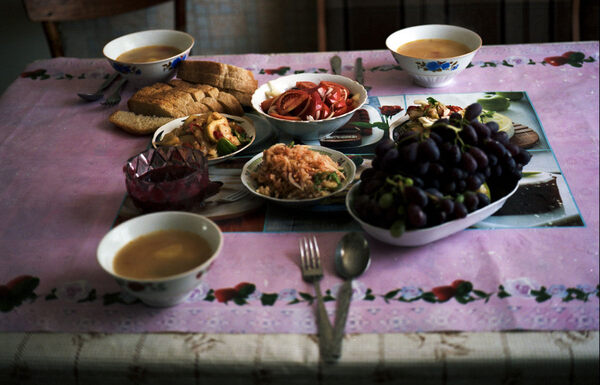
The article at AtlasObscura about food customs brought to Kazakhstan after the 1937 transport of people from Korea to Central Asia is detailed and eye-opening for many readers. This sad chapter of forcible uprooting is told at length in David Chung's 2007 documentary, Koryo Saram: The Unreliable People.
| | In 2010 Dave Cook, a food writer with a talent for highlighting lesser known cuisine, endorsed a mom-and-pop cafe just off Brooklyn's Brighton Beach boardwalk in the New York Times. By writing ... www.atlasobscura.com |
The *Ask a Korean Studies Librarian!* service is provided by the Korean Collections Consortium of North America (KCCNA).
This free reference service is for colleagues, scholars, and students who do not have access to a Korean subject specialist at their own institutions.
Send reference inquiries regarding Korea Studies in English or Korean language to *<askkorea@kccna. libsanswers.com>
---[Pr. David Plath writes, 6/2017] So Long Asleep (60 minutes) follows an international team of East Asian volunteers as they excavate, preserve and repatriate the remains of Korean men who died doing slave labor in Hokkaido during the Asia-Pacific War. On the 70th anniversary of the end of the war we travel with them as they carry 115 sets of remains on a pilgrimage across Japan and over to Korea for reinterment in the Seoul Municipal Cemetery. Using a dark past to shape a brighter shared future the project offers an upbeat model for remembrance and reconciliation that could be adapted widely.
The film and the repatriation project are featured in a 4-page special segment of the Spring 2017 issue of Education About Asia.
See the DER website to view a trailer. Dialogue is in English, Korean and Japanese; in the DER edition the dialogue carries English subtitles. Separately, project participants have prepared editions with subtitles in Korean and in Japanese. For the Korean version, contact Professor Byung-Ho Chung (bhc0606at gmail) and for Japanese contact Professor Song Ki-Chan (kichans at hotmail).
An extended essay by Pr. Chung about the project appears in Asia-Pacific Journal; Japan Focus online magazine, as well, http://apjjf.org/2017/12/Chung.html | | apjjf.org 1. Excavation. A chance encounter drew me into the work of excavation and repatriation of the remains of Korean forced labor victims in Hokkaido. |
cross-posting from koreanstudies.com 2/2017 =-=-=-=-=-=-= The Center for International Affairs at The Academy of Korean Studies(AKS)is pleased to announce the publication of Geography of Korea, the seventhbook in the Understanding Korea series.
This work has been created to serve as a foundational text for international readers to understand the geographic characteristics of the Korean Peninsula and the living culture of Koreans. It consists of an overview that presents a comprehensive look at the Korean Peninsula from a systematic geography perspective and a regional geography portion that examines specific regions of Korea in greater depth.
https://intl.ikorea.ac.kr:40666/korean/viewtopic.php?t=5240The Center for International Affairs, The Academy of Korean Studies 323 Haogae-ro, Bundang-gu, Seongnam-si, Gyeonggi-do, 13455, Republic of Korea
...publication of "Brief Encounters: Early Reports of Korea by Westerners," cmpiled and edited by Brother Anthony of Taiz? and Robert Neff Seoul Selection http://www.seoulselection.com/ 359 pages with 10 pages of coloured illustrations ISBN: 9781624120787 The Table of Contents can be viewed at http://anthony.sogang.ac.kr/BriefEncountersContents.htmlMost of the texts selected (and published here with only minimal editorial introductions and notes) are already available online in my home page through the 3 links at the top of my 'Old Books" page http://anthony.sogang.ac.kr/BooksKorea.htm (a page which also list links to a few hundred online old books about Korea and other similar materials). The intention is to give a fairly full picture of what was reported in Europe about Joseon / Corea / Korea before the diplomatic opening. To widen the scope a little, I have translated a few texts from French, including some pages from Charles Dallet. Obviously, we hope that this anthology will be useful in the classroom but most of what it contains is entertaining enough to be read during the long winter nights at home for pleasure. [cross-posting from koreanstudies.com e-list Brother Anthony]
National Public Radio had a radio segment this morning, June 20, by Elise Hu about a summer camp for children age 5 to teen years to learn about people and social experiences in the DPRK with a view to facilitate eventual reunification. The online version includes photos and transcript, in addition to the audio segment itself.
| |  | Morning Edition Hear the Morning Edition program for June 20, 2016 | | | |
Yes, There's A Summer Camp Dedicated To Learning About North Korea [excerpt from transcript]
There's a summer camp on every theme these days, even North Korea. South Korea's twist on extracurricular enrichment is called Unification Leaders Camp, and it's a government-sponsored getaway dedicated to schooling South Korean youngsters about their neighbors to the north.
At a recent camp session on South Korea's Jeju Island, 120 ninth-graders rolled their suitcases into a sprawling beach-side resort lined with palm trees, snapping selfies on the resort lawn. It was the last they'd see of the outdoors for two days.
[full story in audio, photos; transcript]
| | | | Yes, There's A Summer Camp Dedicated To Learning About North Korea On a beach resort in southern South Korea, the government sponsors camps each year where kids as young as six ar... | | | |
cross-posting from the KoreanStudies email listserv on May 24, 2016:
Announcing the publication (some weeks ago now) of the latest edition of the periodical Manoa, from the University of Hawai'i Press, an anthology of modern Korean poetry titled "The Colors of Dawn: Twentieth-Century Korean Poetry, General Editor Frank Stewart, Guest Editors Brother Anthony and Chung Eun-Gwi." [ISBN 978-0-8248-6622-8]
The volume begins with a succinct overall review of the history of Korean poetry from the early 20th century until the present. We have mainly focused on poets living and writing today, so the order of poets is reversed and the book opens with the youngest and ends with the oldest. The order is determined by the year of birth. Despite the title, many of the poems included were in fact written after 2001. The number of poems for each poet varies between 1 and 10.
The translations of several of the older poets were done by the senior Korean poet and translator, Kim Jong-Gil. Otherwise, the main translators are the two guest editors. The text is freely visible through Project Muse https://muse.jhu.edu/issue/32995 but the physical book is beautifully illustrated with botanical watercolors by Hye Woo Shin. The editors are most grateful to Frank Stewart for inviting them to produce this new anthology. Only a few of the poems included have been published before. The names of the poets represented are listed below (a few of the romanizations have since been corrected in a second printing). Brother Anthony, Dankook University, Sogang University
Part One: Poetry of Today Kim Sunwoo
Jin Eun-Young
Shim Bo-Seon
Hwang Gyu-gwan
Park Seo-yeong
Kim So-yeon
Song Kyung-dong
Kim Ju-Tae
Ra HeeDuk
Lee Yeong-gwang
Kim Sa-inChoi Jeong-rye
Baek Mu-san
Do Jong Hwan
Ko Hyeong-ryeol
Kim Soo-Bok
Kim Seung-Hee
Lee Seong-bok
Jeong Ho-Seung
Lee Si-Young
Kim Nam-Ju __________________________
Part Two: Survivors of War
Shin Dal-ja
Kim Kwang-kyu
Kim Chi-haChonggi Mah
Shin Gyeong-nim
Ko Un __________________________ Part Three: Founding Voices Bak Seong-ryong
Cheon Sang-byeong
Cheon Bong-gon
Pak In-Hwan
Kim Jong-gil
Kim Chun-su
Han Ha-Un
Ku Sang
Yun Dong-juBak Du-jin
Bak Mog-weol
Midang Seo Jeong-ju
Yi Yong-ak
Kim Ki-rim
Yu Chi-hwan
Kim Tong-Hwan
Sim Hun
This call for authors to submit articles may be of interest to those keen on visual communication, but to those wishing to view examples, too, this article points to a place to see stories published to date:
Cross-Currents: East Asian History and Culture Review, a quarterly, open-access online journal, is accepting proposals for photo essays for the September 2016 and March 2017 issues (and beyond). Photo essays include: 1) 20-40 high-quality images with descriptive captions and complete source information, 2) a curator's statement, and 3) a longer non-peer reviewed essay (8-15 pages) contextualizing the photographs and highlighting their significance for current trends of inquiry in Asian studies. This essay can be written by the curator or by an invited scholar. To view archived Cross-Currents photo essays, please click here. The photographs should be taken in China, Korea, Japan, or Vietnam. They may be contemporary images taken as part of the curator's research or archival materials. Please consult the Cross-Currents mission statement to determine whether the proposed essay fits within the journal's historical and disciplinary scope. Obtaining copyright permissions for all images is the responsibility of the curator. Proposals should include: 5-10 sample images (as a single PDF); a one-page description of the theme of the essay and the timeliness/importance of the images to scholars of Asia; a brief bio paragraph about the curator; and complete contact information.
Please send omissions to
Royal Asiatic Society Korea Branch, CPO Box 255, Seoul 100-602, Korea Phone +82 (02) 763-9483 FAX (02) 766-3796 FAX from the US or Canada 1-435-415-2393
as of December 2015:
Korean Poetry in English translation -title in English -author -translated by -publisher
________________________________________
Beating on Iron
Kim Soo-Bok
Translated by Brother Anthony
Green Integer
Maninbo: Peace & War
Ko Un
Translated by Brother Anthony / Lee Sang-Wha
Bloodaxe
Patterns
Lee Si-Young
Translated by Brother Anthony / Yoo Hui-Sok
Green Integer
Wild Apple
Heeduk Ra
Translated by Daniel Parker etc
White Pine
The Colors of Dawn: Twentieth-Century Korean Poetry
An anthology of poems by 44 poets
Translated by Brother Anthony, Chung Eun-Gwi, etc
Manoa (University of Hawai?i Press, early 2016)
Korean novels in English translation
The Girl Who Wrote Loneliness
Kyung-Sook Shin
Translated by Ha-Yun Jung
Pegasus
The Investigation
J. M. Lee
Translated by Chi-Young Kim
Pegasus
Princess Bari
Hwang Sok-Yong
Translated by Sora Kim-Russell
Periscope
Nowhere to Be Found
Bae Suah
Translated by Sora Kim-Russell
Amazon Crossing
The Salmon Who Dared to Leap Higher
Ahn Do-hyeon
Translated by Deborah Smith
PanMacmillan
The Vegetarian
Han Kang
Translated by Deborah Smith
Portobello Books
Human Acts
Han Kang
Translated by Deborah Smith
Portobello Books (January 2016)
Modern Family
Myeong-kwan Cheon
Translated by Kyoung-lee Park
White Pine
The Future of Silence: Fiction by Korean Women
9 authors
Translated by Ju-Chan Fulton / Bruce Fulton
Zephyr (February 2016)
Dalkey Archive?s Library of Korean Literature added 5 more titles late in 2015:
Son of Man
Yi Mun-yol
Translated by Brother Anthony of Taiz?
A Good Family
Seo Hajin
Translated by Ally Hwang & Amy Smith
God Has No Grandchildren
Kim Gyeong-uk
Translated by Sunok Kang
The Private Lives of Plants
Lee Seung-U
Translated by Inrae You Vinciguerra & Louis Vinciguerra
Rina
Kang Young-sook
Translated by Kim Boram
These are in addition to last year's 14 Dalkey Archive Korean Literature volumes:
Stingray by Kim Joo-young
One Spoon on This Earth by Hyun Ki Young
When Adam Opens His Eyes by Jang Jung-il
My Son?s Girlfriend by Jung Mi-kyung
A Most Ambiguous Sunday, and Other Stories by Jung Young Moon
The House with a Sunken Courtyard by Kim Won-il
At Least We Can Apologize by Lee Ki-ho
The Soil by Yi Kwang-su
Lonesome You by Park Wan-suh
No One Writes Back by Jang Eun-jin
Pavane for a Dead Princess by Park Min-Gyu
The Square by Choi In-Hun
Scenes from the Enlightenment: A Novel of Manners by Kim Namcheon
Another Man?s City by Ch?oe In-Ho
Asia Publishers have continued to add to their K-Library of Korean short fiction in bilingual volumes in 2015:
Kong?s Garden by Hwang Jung-eun
Danny by Yun I-hyeong
Homecoming by Cheon Myeong-kwan
|